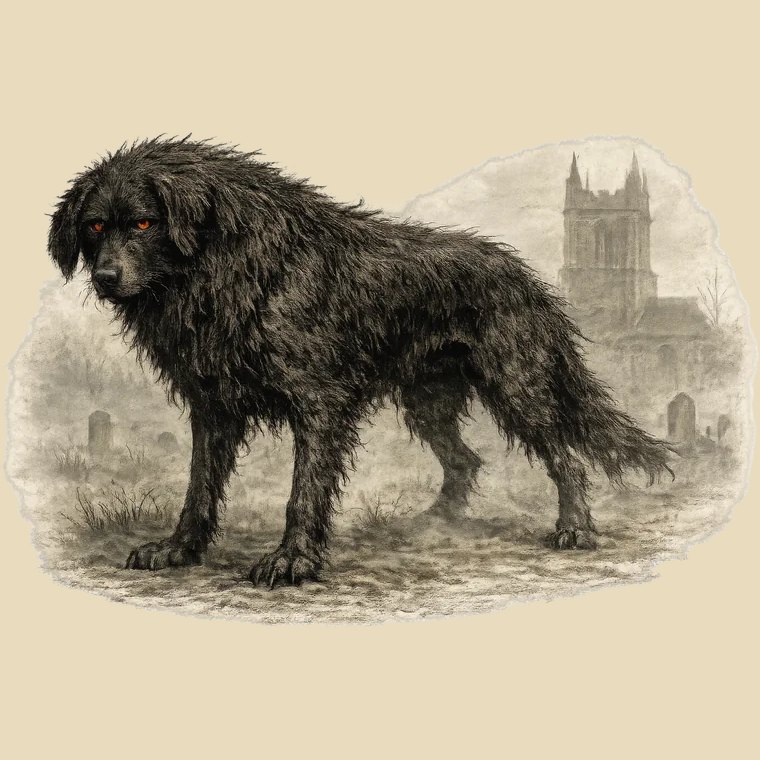
What is Black Shuck?
Black Shuck is the name East Anglian folklore gives a large black dog. Its oldest documented appearance is in a pamphlet printed in London in 1577, which reports a black dog in the churches at Bungay and Blythburgh, Suffolk, on Sunday 4 August of that year.
The pamphlet itself gives very little of the animal. Fleming calls it only “a dog as they might discerne it, of a black colour.” The name Shuck comes later. An 1850 note in Notes and Queries adds a shaggy coat, fiery eyes and immense size, and places the dog in East Norfolk and Cambridgeshire, in churchyards at midnight and on a lane at Overstrand.
What happened at Bungay
By Fleming’s account, a storm broke over Bungay between nine and ten in the morning, during divine service. A black dog appeared in the church. It ran down the body of the church among the people, and two who were kneeling at prayer as it passed died where they knelt. Another man, gripped on the back as it went by, was left shrunk up. The congregation, Fleming writes, thought doomsday already come.
“This black dog, or the diuel in such a likenesse (God hée knoweth al who worketh all) runing all along down the body of the Church with great swiftnesse, and incredible haste, among the people …”
What happened at Blythburgh
The same day, Fleming reports, the dog was seen at Blythburgh, on the rood beam of the church. It swung down through the church, killed two men and a lad, and flew out.
The marks on the door
Fleming set the creature’s claw marks in the stones and door of Bungay church. The marks shown today are on the north door of Holy Trinity, Blythburgh, and local tradition gives them to the same morning.
Who wrote the account
Abraham Fleming was a London editor. He wrote from London, at second hand, and printed his pamphlet from the reports of others, “according to the written copye,” in the same year. The British Library holds a copy of the 1577 printing.
Sources
- Abraham Fleming, A Straunge and Terrible Wunder Wrought Very Late in the Parish Church of Bongay, London, 1577.
- Notes and Queries, 1850, the note on the Shuck of East Norfolk and Cambridgeshire.
Volume One of The Night Field Guide carries the full entry: the plate and its specimen studies, the field notes, and the 1577 text transcribed with cuts marked.